Snow removal & salting
Winter response for commercial and strata properties: entries, sidewalks, accessible routes, and parking lanes cleared before your building opens, with salting matched to the surface and a time-stamped log of every visit.
Scope of work
How a winter event is run
Forecast monitoring
Environment Canada and local forecast data are monitored daily through the season; crews are staged when a qualifying event is projected.
Anti-icing pre-treatment
Where the forecast supports it, surfaces are pre-treated before snowfall so bonding is prevented and clearing takes a fraction of the time.
Trigger mobilisation
Crews mobilise at the accumulation threshold in your agreement — typically 2 cm — targeting completion before first occupancy.
Clear in priority order
Accessible routes and primary entries first, then sidewalks, then parking and drive aisles, so life-safety and bylaw exposure closes earliest.
Targeted de-icing
Product is applied at calibrated rates for the surface and temperature, avoiding over-application near landscaping and new concrete.
Log and report
Arrival/departure times, temperatures, products, quantities, and photos are recorded and issued to you after every response.
Downtown Vancouver mixed-use podium — winter program
A 24-storey mixed-use tower with ground-floor retail, a strata residential lobby, and an underground parkade ramp on a graded street. The property had been using an on-call contractor and repeatedly missed the municipal 10:00 AM sidewalk deadline during the first storm of the season, generating tenant complaints and one bylaw warning.
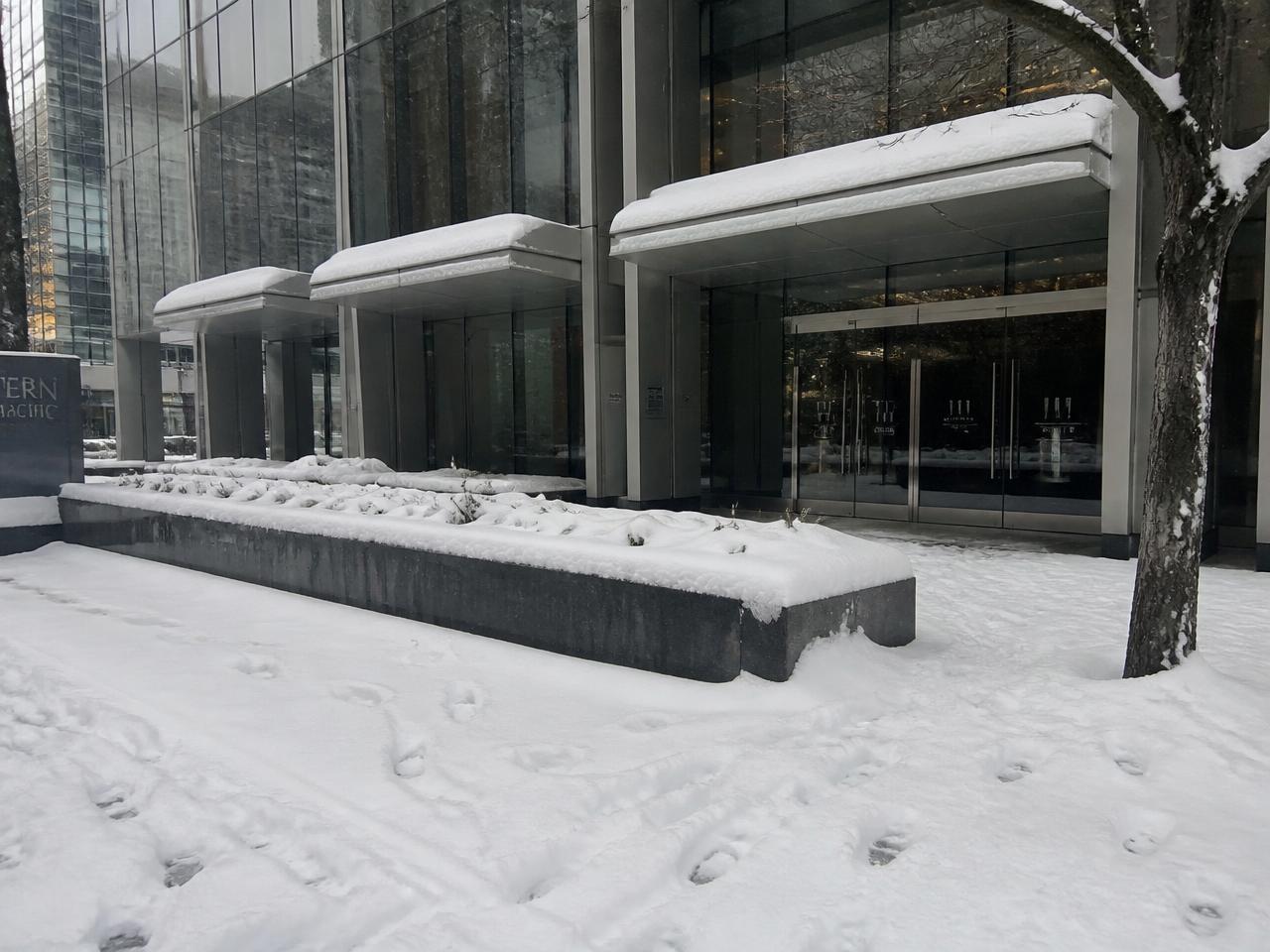
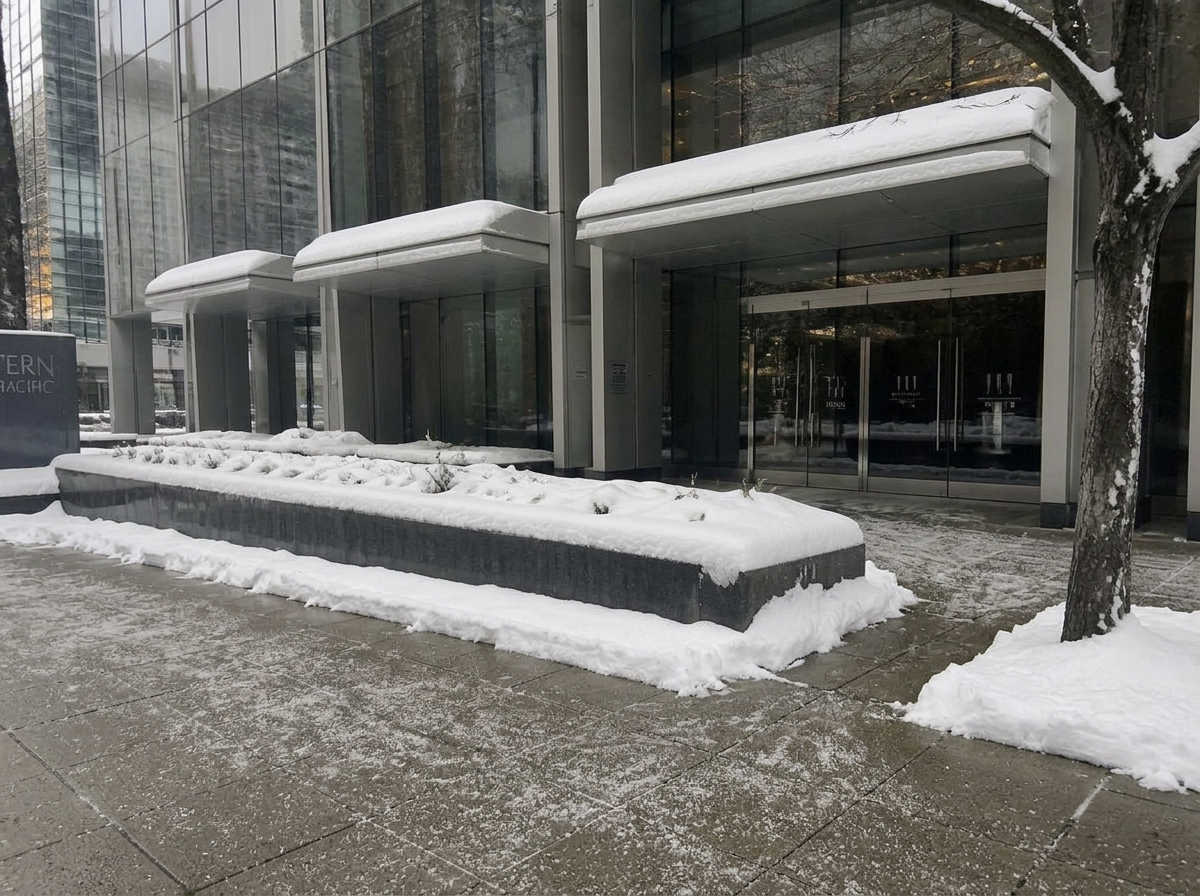
- OctoberPre-season walkthrough
Site mapped with the account manager: priority routes, snow-stockpile zones, drain and hydrant clearances, surface sensitivities.
- November 1Staged and ready
Salt bins placed, product selected per surface, response plan and service-log template issued to the council and building staff.
- 01:40Trigger mobilisation
Accumulation hits the 2 cm contract trigger; crew dispatched with pre-treatment already applied to the ramp and entries.
- 04:15Entries and accessible routes clear
Three entries, two accessible ramps and the parkade apron cleared and de-iced before the first residents leave the building.
- 06:00Sidewalks complete
1,850 ft of public sidewalk finished — four hours ahead of the municipal 10:00 AM bylaw deadline.
- 08:30Log issued
Time-stamped log with temperatures, products, quantities and photographs delivered to the property manager and archived for the season.
- Scope1,850 ft of public sidewalk, three entries, two accessible ramps, the parkade ramp apron, and a loading bay, on a 2 cm trigger with pre-treatment.
- Result — complianceZero bylaw complaints and zero missed deadlines across the season's contracted response events.
- Result — liabilityNo slip-and-fall claims filed. Every event carried a photographed, time-stamped log the insurer accepted without follow-up.
- Result — budgetA fixed seasonal contract replaced per-call invoicing, removing the storm-premium spikes that had blown the prior year's operating budget.
Download the winter response plan & service-log template (PDF) — the same document we issue to strata councils and asset managers, covering triggers, priority sequence, product selection, and the record-keeping an insurer expects.
Download the winter safety & salting methodology standard (PDF) — Vancouver climate baseline, application rates by temperature and surface, crew safety standard, slip-prevention evidence requirements, and the season-long maintenance checklist for your building staff.
Model a Vancouver winter budget — per event or seasonal
Set your serviced hardscape, service level and winter scenario against Metro Vancouver snowfall normals, then compare per-event billing with a seasonal bundle. Download the branded budget PDF, or send the same numbers straight to our team as a proposal request.
Sidewalks, entries, ramps, drive aisles and parking lanes actually cleared. Estimated from the property footprint at 2,125 sq ft — drag to match your site.
Sidewalks clear by the 10:00 AM municipal bylaw deadline.
About 28 cm across the season, concentrated in December and January. Metro Vancouver averages about 28 cm per season, concentrated in December and January — the model is scaled to that reality, not to an interior Canadian winter.
Pay only for responses that actually happen. Best for properties with low exposure that can absorb an unpredictable winter line item.
A severe Vancouver winter (~62 cm, like the 2021/22 cold snap) would trigger about 5 responses on the Standard tier — 2 more than modelled here. Each additional response adds $310 – $430, or $720 in total. A seasonal bundle removes the storm-premium exposure of paying event by event.
Checking the live weather feed…
What drives the price
- Serviced areaTotal square footage of sidewalk, entries, ramps, and parking surface in scope.
- Trigger thresholdA lower accumulation trigger means more responses per season and a higher seasonal rate.
- Completion deadlinePre-dawn completion for an office tower costs more than daytime clearing at an industrial site.
- Snow storageSites with nowhere to stockpile require hauling, which is quoted separately per load.
- Surface sensitivityNew concrete, pavers, and planted edges require lower-chloride products at a higher material cost.
- Contract modelFixed seasonal contracts price lower per event than on-call service and hold priority in the queue.
Frequently asked questions
How does the short Vancouver snow season affect pricing?+
Our estimator is tuned for a typical Metro Vancouver winter — only a handful of accumulating snowfalls most years — so the seasonal budget is far lower than an interior Canadian market. Per-event billing is also available if you prefer to pay only when snow actually falls rather than carrying a fixed seasonal contract.
How quickly do you mobilise after snowfall starts?+
Contracted sites are on a monitored trigger — crews mobilise when accumulation reaches the threshold in your service agreement (typically 2 cm) so that entries, sidewalks, and accessible routes are clear before the first occupants arrive. Overnight and pre-dawn service is the default for office and retail properties.
Do you document the work for liability purposes?+
Yes. Every response is logged with arrival and departure times, surface temperature, product applied and quantity, and photographs of cleared surfaces. Slip-and-fall claims are usually decided on documentation, so the log is issued to you after each event and archived for the season.
What de-icing products do you use?+
Product is matched to the surface and temperature: traditional salt on asphalt and durable concrete, and lower-chloride or magnesium-based blends near new concrete, landscaping, underground parkade entries, and pet-traffic areas where chloride damage or run-off is a concern.
Is snow removal billed per event or per season?+
Both models are available. Per-event billing suits properties with unpredictable exposure; a fixed seasonal contract gives strata councils and asset managers a predictable budget line and guarantees priority in the response queue during a major storm.
Do you cover the legal sidewalk-clearing bylaw requirements?+
Yes. City of Vancouver and most Metro Vancouver municipalities require property owners to clear adjacent public sidewalks by 10:00 AM the day after a snowfall. Our sidewalk scope is written to meet that deadline, and the service log is your evidence of compliance if a bylaw complaint is filed.
Can snow service be added to an existing window cleaning contract?+
Yes — it is the most common way clients add it. Same insurance, same WorkSafeBC clearance, same account manager, and one consolidated invoice with your existing exterior maintenance program.
What is your salting methodology, and how much product do you apply?+
Product is chosen by surface temperature and substrate, then applied at a calibrated rate rather than by eye. Above -7 °C on asphalt and mature concrete we use rock salt at roughly 8–12 g/m² for anti-icing and up to 20 g/m² for de-icing after clearing. Between -7 °C and -15 °C we switch to magnesium chloride or a treated-salt blend, because plain rock salt stops working and simply washes away. Below that, traction grit plus mechanical removal is the honest answer. We always clear first and then apply — salt spread over unremoved snow is wasted product and a slush hazard.
How do you protect new concrete, pavers, and landscaping from salt damage?+
Concrete under one year old, pavers, planted edges, parkade entries, and pet-traffic routes are mapped in the pre-season walkthrough and specified for low-chloride or magnesium-based product at reduced rates. Residual product is swept and recovered after the melt to limit chloride run-off into storm drains, and we recommend rinsing entry glass, aluminium frames, and stainless at season end to prevent etching and pitting.
What are the actual timelines during an event?+
The forecast is monitored daily through the season and crews are staged when a qualifying event is projected. Anti-icing pre-treatment goes down ahead of forecast freezing precipitation. Mobilisation happens at your contract trigger, then clearing runs in priority order: accessible routes and curb cuts, primary entries and stair landings, public sidewalks before the municipal deadline, then parking lanes and loading bays. Re-check and re-application passes run through multi-day events, and the time-stamped log is issued after every response.
How does a severe winter affect the budget I've modelled?+
The estimator models a typical Metro Vancouver season of roughly 28 cm, concentrated in December and January. A severe winter like the 2021/22 Arctic outflow can push a Standard-tier site from three responses to five or six. The weather-event alert in the estimator shows exactly what each additional response costs, so the overrun is a known number rather than a surprise. A seasonal bundle caps the modelled events and holds your queue priority; anything beyond that is billed at the per-event rate you already have in writing.
What maintenance should the property handle between responses?+
Keep entrance matting long enough to absorb tracked-in melt and swap saturated mats during an event; post wet-floor signage at every entry; confirm exterior lighting works before November, since most responses happen in the dark; fix drainage low points in the fall, because refreeze at a known puddle is a predictable claim; and keep salt bins stocked so building staff can spot-treat between contracted responses. All of this is in the downloadable winter safety and salting standard.
Related pages
Model a winter budget in the budget estimator (select snow removal and salting), review our insurance and safety credentials, or see recent work in our case studies.
Trusted through Metro Vancouver winters
Verified feedback from property and facility managers on our exterior maintenance programs.
Read our reviews on Google →“The Spiffy Window Cleaning crew arrived on schedule, were courteous, worked diligently and did a great job. The windows look fantastic. An added bonus - the management and employees are customer oriented and responsive.”
“Class act! Super easy to book and showed up on time and did a stellar job! I had all of the glass windows cleaned and let me tell you winter was unkind to all of our sliding glass doors and now they are perfection. Will be booking them again soon!”
“David and all of the team at Spiffy are good guys who aim to please. They did a wonderful job on my windows, gutters inside and out, and my deck glass which was covered in years of green algae. I didn't think I needed cleaning, but after it was done, I must say, I do enjoy my clear views.”
Related services and coverage
The pages most closely connected to this one, plus the areas we service nearby.
Post-Construction Cleaning
Handover-grade glass, frame, and hard-surface cleaning with concrete slurry and sealant removal.
Read more →High-Rise Window Cleaning
Rope access, swing stage, BMU, and water-fed pole glazing programs with documented anchor and rescue plans.
Read more →Pressure & Soft Washing
Plazas, parkades, walkways, and cladding cleaned at the correct pressure for the substrate, with water containment.
Read more →Coquitlam
Commercial and high-rise window cleaning, pressure washing, and gutter clearing for Coquitlam Centre towers, Burquitlam strata highrises, and Coquitlam business park properties.
Read more →Port Coquitlam
Window cleaning, pressure washing, and gutter clearing for Port Coquitlam industrial estates, Dominion Triangle retail, and low-rise commercial and civic buildings.
Read more →Port Moody
Commercial and strata window cleaning, pressure washing, and gutter clearing for Port Moody's Suter Brook and Klahanie towers, Brewers Row, and Moody Centre commercial.
Read more →Secure winter coverage for your property
Seasonal capacity is limited and allocated in order of contract. Tell us the site and we'll scope a response plan.